
ACI Postilion
The switching, issuing and acquiring glue: hosted, extended and operated by the group as an authorised ACI reseller.
Postilion is ACI Worldwide’s retail payments platform: a modular system used by banks, processors and merchants to authorise, route and settle electronic payments across every channel they run. Its open-systems design lets internal and external channels exchange information through a single switch rather than a series of point-to-point integrations.
ACI publishes that its software powers electronic payments for 19 of the world’s 20 largest banks and more than 80,000 merchants, processing over US$14 trillion in payments and securities transactions each day for customers in 95 countries. Postilion is the platform on which the group’s payments practice is built.
The group licenses, hosts, extends and operates it, and institutions that want the rails without the estate take it as Postilion-as-a-Service. ACI software, domestic cloud and engineers who work the platform daily: that combination is what turns the switch behind the sector into a managed service rather than a project.
The platform at a glance
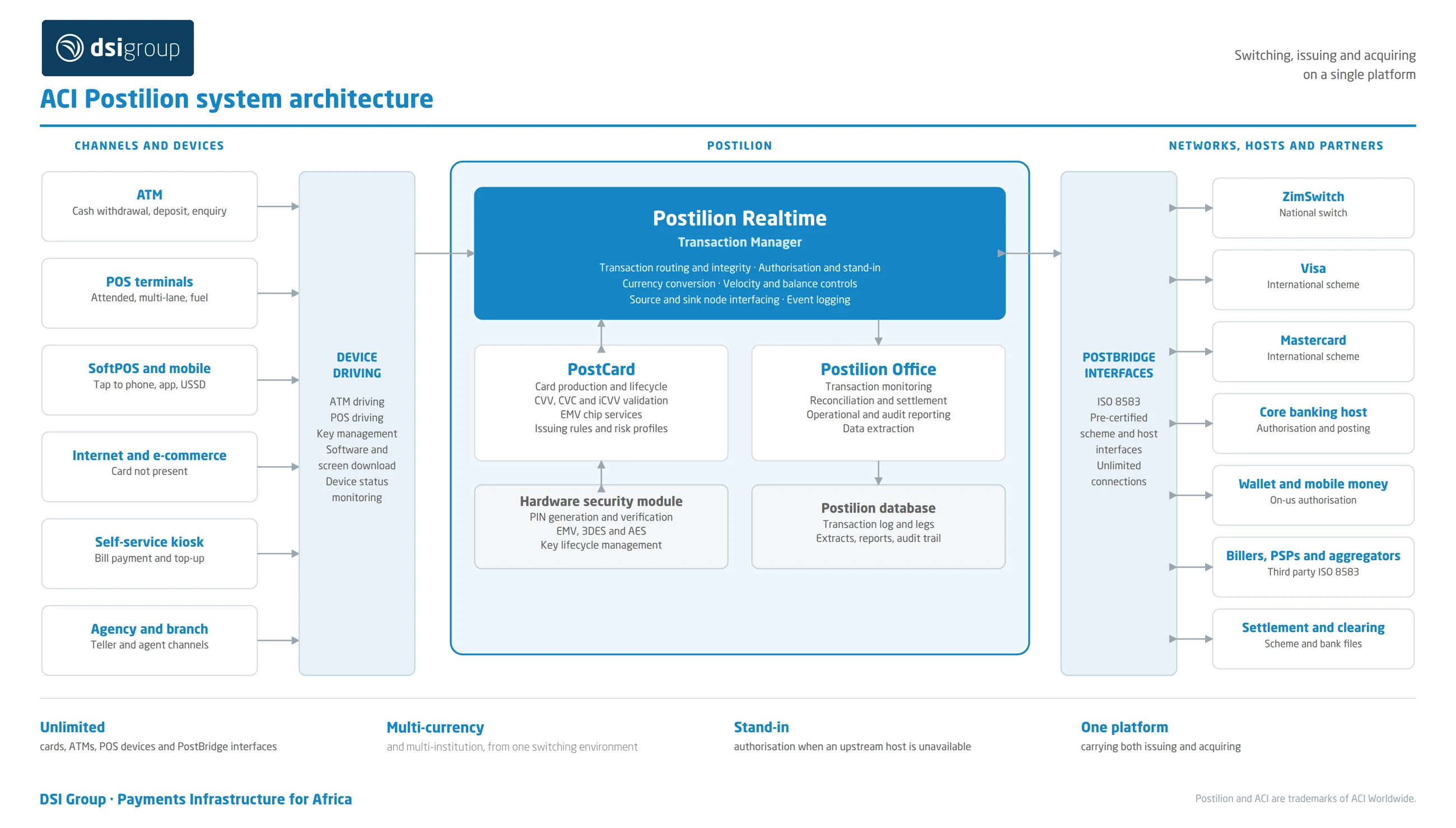
Channels and devices are driven by Postilion, switched through Postilion Realtime, and connected outward to national and international networks, hosts and partners through PostBridge interfaces. Card management sits in PostCard, and post-transaction processing in Postilion Office, away from the live path.
Four modules, one platform
Postilion is delivered as a set of modules that can be taken together or in part.
Inside Postilion Realtime
- Intelligent transaction routing. When a card is presented at a terminal, Realtime determines exactly where the request should go, for example routing a Visa transaction from a local ATM back to the cardholder’s issuing bank.
- Transaction integrity and stand-in authorisation. Realtime manages the full lifecycle of a transaction, maintains its integrity and security, and provides currency conversion. Where an authorisation system is temporarily unavailable, it can stand in and approve or decline against pre-set risk limits.
- Data security and HSM integration. Realtime handles the cryptography, interfacing with hardware security modules to process PIN validation, 3DES and AES encryption and EMV chip authentication, supporting a PCI DSS compliant environment.
- Source and sink node interfacing. Realtime bridges sources, where transactions originate, such as ATMs and POS terminals, and sinks, where they are sent, such as Mastercard, Visa, ZimSwitch or a core banking host.
Inside Postilion Office
- Transaction monitoring. A single source of information for near-real-time analysis of every transaction processed, without affecting the performance of the live system.
- Reconciliation. Reconciles transaction data against files provided by third parties, including schemes, networks and settlement partners.
- Reporting. Schedules and generates operational, financial and audit reports.
- Data extraction. Queries and extracts detailed transaction logs from the underlying Realtime database for clearing, settlement and business reporting.
Inside PostCard
- Card lifecycle and production. Configuration, production and distribution of physical and virtual cards, covering permanent, temporary and anonymous cards, and the adding, activating, reissuing and replacing of cards. This extends to corporate cards, gift cards and prepaid profiles.
- Validation and security services. Authentication at the point of origin, including validation of CVV and CVC values, EMV chip services, chip authentication and iCVV checks.
- Authorisation and risk management. Velocity checks limiting how often or how much a cardholder may spend in a given period, full balance evaluation, and stand-in authorisation profiles for use when the host network is unreachable.
- User and operator enquiries. Tools for contact-centre staff and platform administrators to track transaction activity in real time, monitor system logs, look up card profiles and resolve customer queries directly.
Driving the terminal estate
Driving is the platform’s ability to control, manage and communicate directly with physical terminals. POS driving connects, configures and manages point-of-sale terminals so they can accept card transactions securely. ATM driving manages automated teller machines, covering cash dispensing, screen layouts, cryptographic key management and status monitoring.
- Terminal communication. The driving software is the bridge between the physical device and the central switch.
- Transaction routing. When a card is presented, the driver captures the message, translates it and passes it to Realtime for authorisation and routing to the correct financial network.
- Device management. Operators monitor hardware health, download software updates and screen states to devices, and manage security keys safely.
Because driving, switching and card management sit on one platform, a single environment can carry both the issuing and the acquiring proposition, and the terminal estate can grow without a separate driving system being introduced alongside it.
Every channel, one switch
What you can run on the platform
Postilion supports multiple payment channels, currencies, transaction types and external networks from one switching environment, which gives an institution a single place to build rather than a separate system for each new product.
None of this has to be introduced at once. The modular architecture allows an institution to build progressively, adding functionality and connectivity in line with its commercial priorities, on a foundation that does not need to be replaced as the proposition widens.
Connectivity without interface constraints
A payments switch becomes more valuable as the number of systems around it grows. Postilion connects to host systems, payment channels and domestic, regional and international networks through configurable interfaces, so additional hosts, networks, processors and payment partners can be introduced as the business requires them while Postilion remains the common switching layer.
Resilience and security
Configurable stand-in authorisation means that, where rules have been defined, selected transactions can continue to be authorised while an upstream authorisation system is temporarily unavailable. Postilion also carries the security capabilities expected in an enterprise payments environment, including cryptographic processing, PIN generation and verification, EMV processing and key lifecycle management. Transaction-level controls can be configured around velocity, balances and stand-in authorisation, giving one consistent control layer across cards, terminals, channels and connected systems.
Control over a critical capability
Operating a dedicated Postilion environment gives an institution control over the switching layer at the centre of its payments operation. Transaction routing, interfaces and network connectivity can be structured around the institution’s own payments strategy rather than around the limits of a third party’s licensing model. As new products launch and new partnerships form, the switch evolves with them, and the institution decides which systems and networks are connected and how transactions are routed.
What it processes
For banks and processors
A multi-channel, multi-currency, multi-institution platform with a wide range of pre-certified network interfaces, so an institution can choose what to offer now without limiting what it can offer later.
- Library of pre-certified network interfaces, with off-the-shelf support for national, regional and international scheme networks and host systems.
- Omni-channel support across ATM, POS, self-service terminals, internet, kiosks, call centres and mobile devices.
- Support for all card types, debit, prepaid and gift, in EMV, contactless and magnetic-stripe formats.
- Secure cryptographic processing, including PIN generation and verification, EMV processing, 3DES and key lifecycle management.
- Modular architecture with the flexibility to extend to new services and products, and to support fast rollout of new features.
- Support for all transaction types, including purchases, cash withdrawals, refunds, transfers, bill payments, wire transfers, pre-payments, recharges and statements.
- Compliance with card scheme mandates, and validation under the applicable PCI software security programme.
- Velocity, balance and full stand-in authorisation services, configured at account or card profile level.
- Complete card management lifecycle support, including production, activation, redemption and reporting.
- Advanced transaction support, including foreign-exchange dispensing, dynamic currency conversion and prepaid top-up.
For merchants and acquirers
The same platform serves the acquiring side of the business, driving terminal estates and routing merchant traffic.
- Modular architecture and open-systems technology for genuine flexibility.
- End-to-end integration from POS devices through to the acquirer.
- Integrated POS terminals in multi-lane, express-lane and fuel environments.
- PCI-validated point-to-point encryption (P2PE) certification.
- Support for EMV, magnetic-stripe and contactless payment formats.
- The opportunity to negotiate lower service charges across multiple acquirers.
- Support for value-added services, including gift cards and prepay.
- Support for a full range of devices and mixed terminal estates.
- Operational tools and centralised configuration.
- Fraud management tools that limit the financial risk of write-offs and losses, and support compliance with industry and government regulation.
Proven at scale
Postilion and the wider ACI retail payments platform are deployed by banks, processors and major retailers worldwide. The organisations ACI publishes as customer references include the following.
The platform also has deep roots in this region. Postilion originated in South Africa and has been deployed across African markets for more than two decades, which is why local engineering skills, scheme certifications and operational experience for the platform are available here rather than only offshore.
Training
ZSS provides Postilion training for customer staff, so that the institution builds its own working knowledge of the platform alongside the service rather than depending on it entirely. Training is delivered on site or remotely, against an agreed syllabus and delegate numbers. Courses can be built around any combination of the following.
Product information on this page is drawn from ACI Worldwide’s published Postilion material. Postilion and ACI are trademarks of ACI Worldwide. The customer references named above are those published by ACI Worldwide and are given as examples of the platform’s deployment base, not as customers of DSI Group or ZSS.